
Certifications
Our manufacturing excellence is backed by nationally recognized standards and certifications. Strict quality controls, advanced testing processes, and compliance with industry benchmarks ensure our plywood consistently delivers durability, safety, and performance across residential, commercial, and industrial applications.
Hover to Enlarge
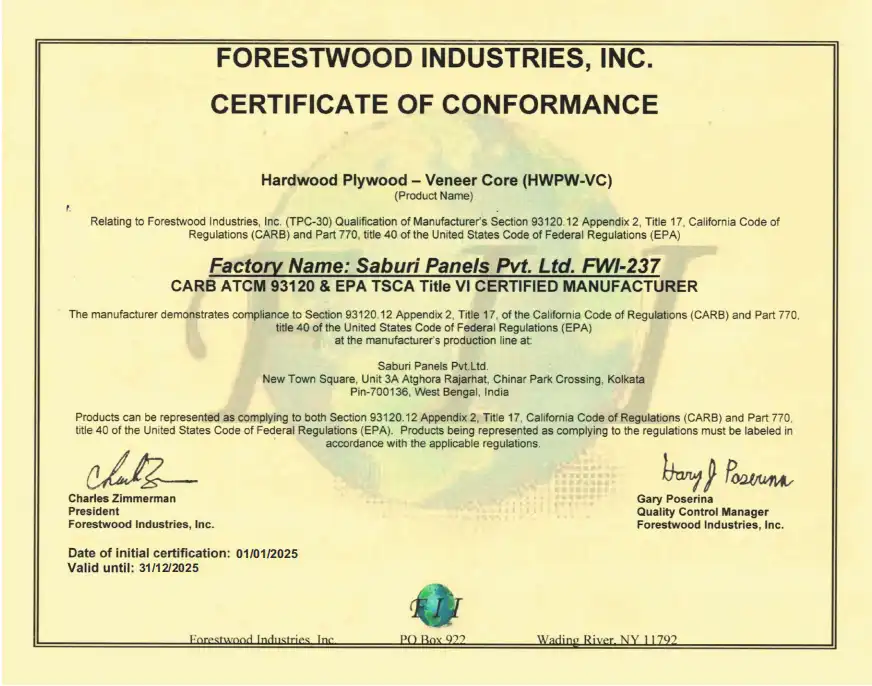
Certificate of Conformance (CARB)
Hover to Enlarge
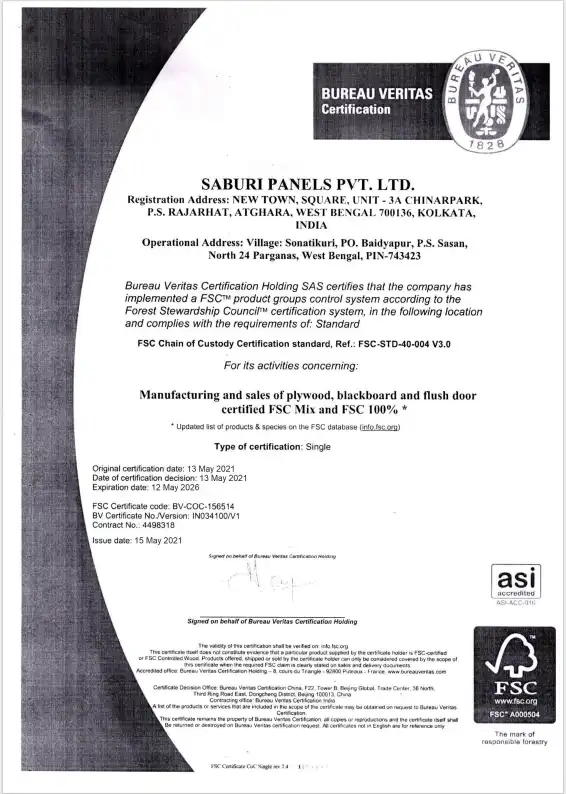
FSC Certificate
Hover to Enlarge
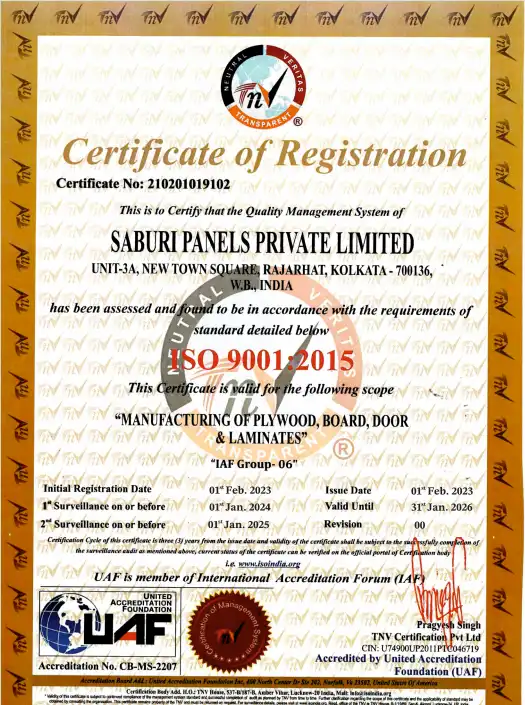
ISO 9001:2015
Hover to Enlarge
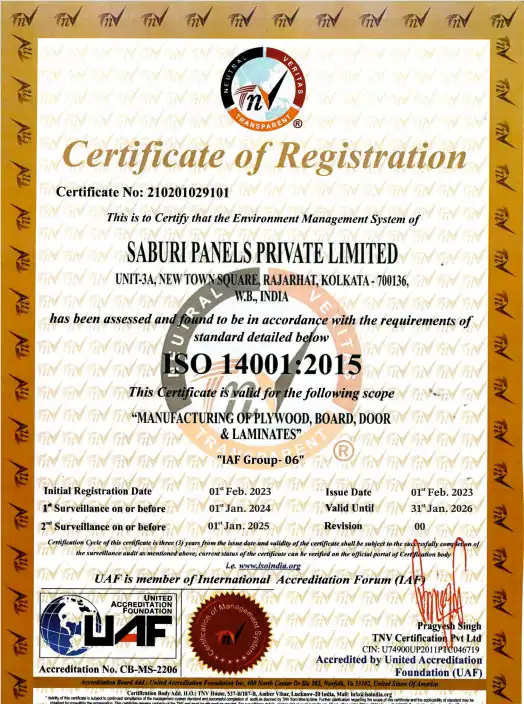
ISO 14001:2015
Hover to Enlarge
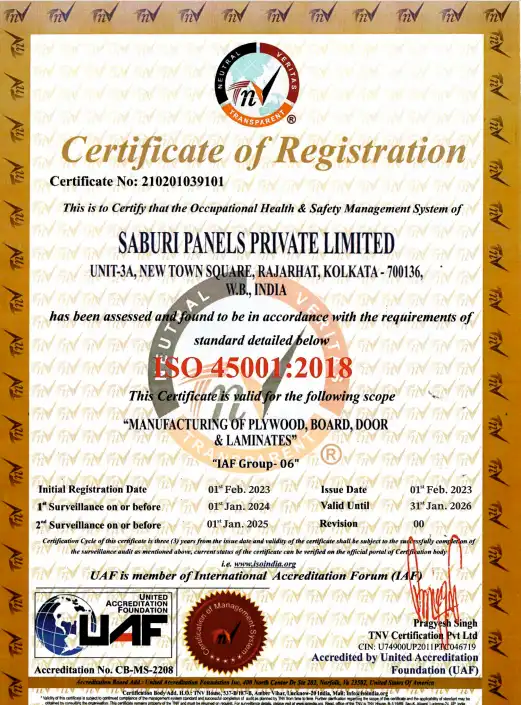
ISO 45001:2018
Hover to Enlarge
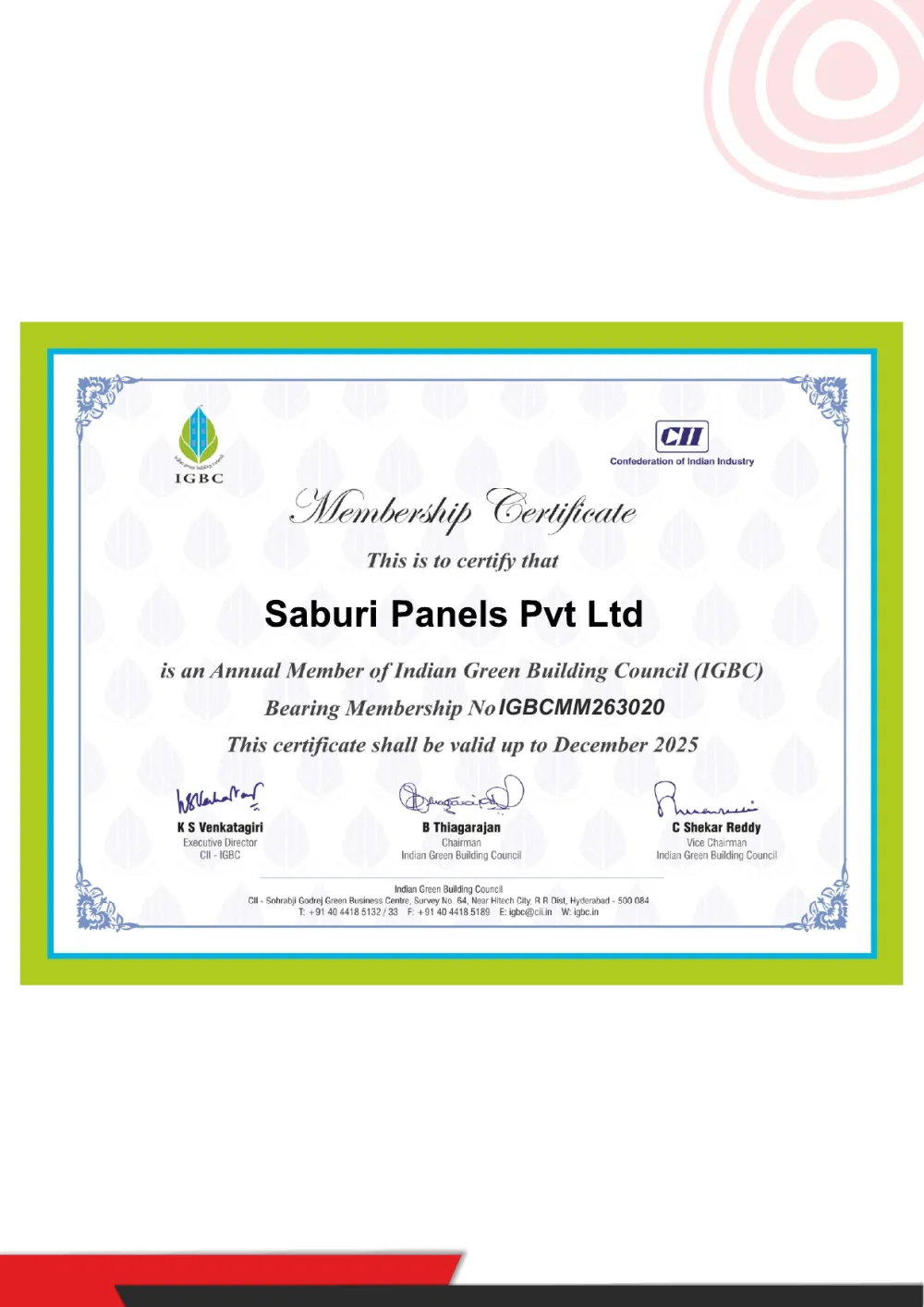
IGBC
Hover to Enlarge
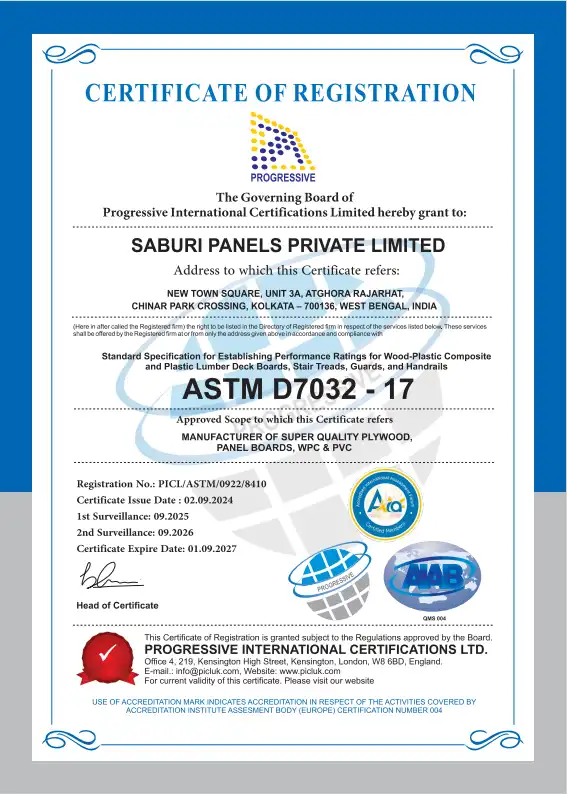
ASTM D7032 - 17
Hover to Enlarge
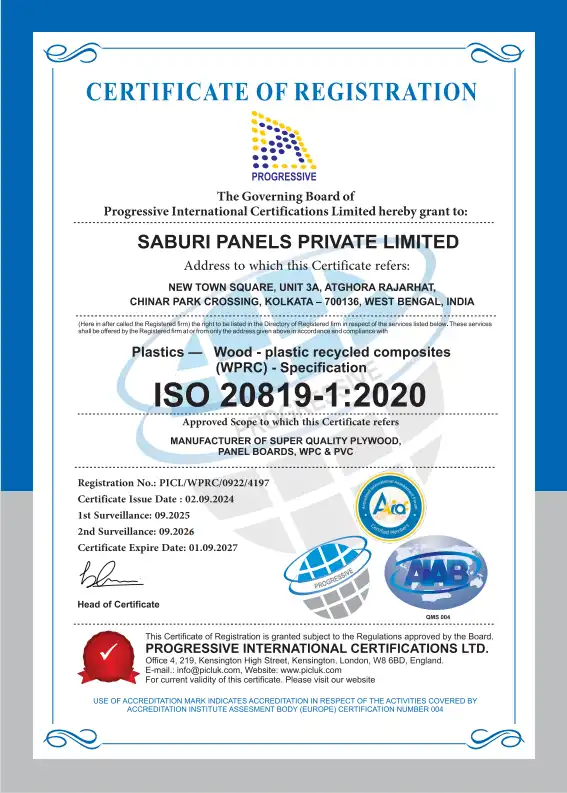
ISO 20819-1:2020
Hover to Enlarge
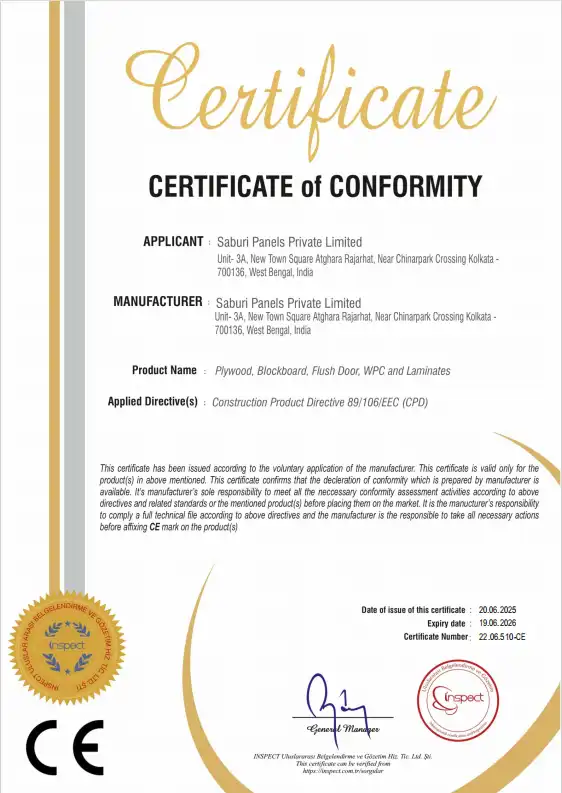
Certificate of Conformity (CE)
Certifications & Quality — FAQs
Saburi Ply holds ISO 9001:2015, ISO 14001:2015, ISO 45001:2018, FSC, CARB, IGBC, and CE under UFA, plus BIS certification under eight IS standards: IS:303, IS:710, IS:1659, IS:2202, IS:5509, IS:10701, IS:4990, and IS:3087.
Saburi Ply maintains India's most comprehensive plywood certification portfolio spanning quality, environment, occupational safety, international trade, and green building. ISO 9001:2015 certifies quality management; ISO 14001:2015 covers environmental management; ISO 45001:2018 addresses occupational health and safety. FSC confirms responsible timber sourcing; CARB certifies formaldehyde emission compliance for North American markets; CE under UFA enables European market access; IGBC recognition supports green building project specification. BIS ISI marking under eight Indian Standards — IS:303, IS:710, IS:1659, IS:2202, IS:5509, IS:10701, IS:4990, IS:3087 — covers every major plywood and panel category.
QuadPro Technology is Saburi Ply's proprietary multi-layer bonding and manufacturing system delivering consistent strength, load-bearing performance, and warp resistance across all premium plywood products. It is applied in Titanium Plus, Perennial, Club H+, Gold 710, and Scout.
QuadPro Technology is Saburi Ply's in-house engineered manufacturing process enforcing uniform adhesive distribution, calibrated mechanical pressing, and enhanced veneer integration throughout every panel. It directly addresses the most common plywood failure mode — inconsistent bonding in core layers — by applying multi-stage pressure treatment across the veneer stack. QuadPro contributes to Saburi Ply's warp-free guarantees, consistent load-bearing performance, and long-term dimensional stability across its premium range. For architects and specifiers, QuadPro-certified products represent a documented engineering standard behind Saburi Ply's lifetime warranty commitments. The technology is a key differentiator from standard plywood manufactured without proprietary bonding process controls.
Saburi Ply's 12-step process covers timber selection, peeling, core separation, drying, core composition, adhesive application with GLP, mat ply pressing, calibration, face overlay press, sanding and trimming, preservative treatment, and dispatch — with eight quality tests per panel.
Saburi Ply's 12-step manufacturing process is the operational foundation behind its warranty commitments and quality certifications. Timber selection ensures only premium hardwood — primarily Gurjan for top-tier products — enters production. Peeling, veneer separation, precision drying, and core composition stages follow. Adhesive application combines phenol-formaldehyde resin with Saburi's proprietary GLP system. Multi-stage pressing, dual-face calibration, face overlay pressing, and precision sanding ensure dimensional accuracy. Preservative treatment provides termite, borer, and antifungal protection. Eight mandatory quality tests — including fire resistance, boiling water resistance, and nail-holding strength — are conducted on every batch before dispatch.
Yes. Saburi Ply holds three ISO certifications: ISO 9001:2015 (Quality Management), ISO 14001:2015 (Environmental Management), and ISO 45001:2018 (Occupational Health and Safety). All three are independently audited and verified.
Saburi Ply's ISO certifications cover three internationally recognised management system standards. ISO 9001:2015 certifies that manufacturing processes, customer service, and product consistency meet global quality requirements. ISO 14001:2015 certifies the environmental management system covering resource consumption, waste, and ecological impact at all plants. ISO 45001:2018 is the international occupational health and safety standard, ensuring worker welfare at Saburi Ply's Kolkata and Vizag facilities. All three certifications require periodic third-party audits for renewal, providing ongoing independent verification. These ISO credentials complement Saburi Ply's BIS, CARB, FSC, CE, and IGBC portfolio to form one of India's most comprehensive plywood manufacturer certification frameworks.
Yes, Saburi Ply holds FSC (Forest Stewardship Council) certification, confirming its timber is sourced from responsibly managed forests. FSC is mandatory for green building project procurement and eco-conscious international buyers.
FSC (Forest Stewardship Council) certification verifies that timber in Saburi Ply's products comes from forests managed with environmental, social, and economic sustainability criteria. For LEED-certified projects in India, FSC-certified materials contribute to the Materials and Resources (MR) credit category. Saburi Ply's FSC certification satisfies procurement requirements of multinational corporations, large Indian corporates, and premium developers that mandate responsible sourcing in their fit-out specifications. Combined with IGBC recognition, E0 emission compliance, and CARB certification, FSC makes Saburi Ply one of India's strongest green building material specifications. Architects and sustainability consultants can request FSC documentation from Saburi Ply's regional sales team for LEED submission purposes.
Saburi Ply holds CARB (California Air Resources Board) Phase 2 certification, which limits formaldehyde emissions to 0.05 ppm — significantly stricter than India's E1 standard. CARB compliance is mandatory for North American markets and increasingly demanded by global buyers.
CARB Phase 2 is one of the world's most stringent formaldehyde emission standards for composite wood products. Its limit of 0.05 ppm for hardwood plywood with veneer core is far more demanding than India's standard E1 requirement. Saburi Ply's CARB certification confirms products meet this standard for North American export and for multinational procurement in India. Beyond exports, CARB compliance is demanded by global retail chains specifying Indian fit-out materials, premium developers marketing to international buyers, and MNCs operating Indian offices. Saburi Ply's CARB certification combined with E0 emission standards and ISO 9001:2015 positions it among the few Indian plywood manufacturers meeting the highest global emission benchmarks.
CE (Conformite Europeenne) marking confirms Saburi Ply products meet European product safety and performance directives under UFA. CE certification is required for products sold in EU and EEA markets and signals quality exceeding domestic BIS requirements.
CE marking is mandatory for goods sold within the European Union and European Economic Area. For plywood manufacturers, CE certification under the UFA directive confirms compliance with European standards for structural performance, emission limits, and safety. CE enables Saburi Ply to supply European contractors and furniture manufacturers that require CE-marked materials. In the Indian market, CE certification signals a quality benchmark beyond domestic BIS requirements, providing additional assurance to premium project buyers and architects applying European standards. Saburi Ply is among a small number of Indian plywood manufacturers holding CE certification simultaneously with CARB, FSC, and ISO credentials — a combination demanded by the most quality-sensitive project specifications.
Saburi Ply holds IGBC (Indian Green Building Council) recognition, making its products eligible for specification in LEED-certified green building projects in India. IGBC recognition supports architects and developers seeking sustainable material documentation for LEED credits.
IGBC is affiliated with the US Green Building Council (USGBC) and administers LEED certification for Indian buildings. IGBC-recognised Saburi Ply products contribute to LEED credit documentation across Materials and Resources, Indoor Environmental Quality, and Energy and Atmosphere categories. Architects and PMCs working on LEED-targeted commercial, residential, or institutional projects can specify IGBC-recognised Saburi products to support point-earning across relevant credit categories. Saburi Neowud's rice husk content, zero formaldehyde, and UL94 V0 fire rating make it particularly relevant for green-certified building projects. The combination of IGBC, FSC, E0, and CARB makes Saburi Ply one of the most comprehensively green-certified plywood manufacturers in India.
E0 is the premium formaldehyde emission standard in Indian plywood — no more than 0.5 mg/L, well below the E1 minimum. Applied across Saburi Ply's premium range (Titanium Plus, Perennial and Club H+), E0 compliance makes these panels among India's safest for indoor air quality. Saburi Neowud (NRFC), made from rice husk with no added formaldehyde resin, is a zero-formaldehyde panel.
Formaldehyde emission in plywood is graded from E2 (highest, being phased out) through E1 (the standard Indian minimum) to E0 (premium, no more than 0.5 mg/L). Saburi Ply's premium range — Titanium Plus, Perennial and Club H+ — is E0 compliant, the highest standard formaldehyde class for Indian plywood. Saburi Neowud (NRFC), manufactured from rice husk with no added formaldehyde resin, goes further as a zero-formaldehyde panel. E0 panels are ideal for children's bedrooms, nurseries, hospitals, and poorly ventilated indoor spaces where long-term formaldehyde exposure risk must be minimised. For LEED Indoor Environmental Quality (IEQ) Credit 4.4, E0 or better is required — Saburi's E0 range meets this threshold, placing it among the highest emission-compliant plywood manufacturers in India.
Saburi Ply holds BIS ISI certification under eight IS standards: IS:303, IS:710, IS:1659, IS:2202, IS:5509, IS:10701, IS:4990, and IS:3087. Each carries a verifiable CM/L number at bis.gov.in.
BIS (Bureau of Indian Standards) certification under the ISI marking scheme is the mandatory quality verification system for plywood sold in India. Each IS standard governs a specific product category with defined performance requirements. Saburi Ply's BIS certification across eight standards — IS:303, IS:710, IS:1659, IS:2202, IS:5509, IS:10701, IS:4990, and IS:3087 — covers the broadest product category range certified by any single manufacturer in India's top 10. Each certification carries a CM/L number verifiable at bis.gov.in. This verification is critical for institutional procurement (hospitals, schools, government buildings) and for architects documenting material specifications for project approvals. BIS verification takes under 2 minutes online.
Saburi Ply conducts eight mandatory quality tests on every panel before dispatch — including fire resistance testing, boiling water resistance (minimum 72 hours for IS:710), nail-holding strength, and additional performance evaluations per BIS standards at all its manufacturing plants.
Saburi Ply's eight-point quality control programme is conducted on every production batch before dispatch from all its manufacturing plants. Boiling water resistance testing — minimum 72 hours for IS:710 certified products — verifies BWP grade adhesive performance. Fire resistance testing confirms IS:5509 compliance for FR Ply products. Nail-holding and screw-holding strength tests verify fastener performance for furniture applications. Additional tests cover tensile strength, shear resistance, moisture content, and dimensional accuracy per applicable IS standards. This eight-point regime is the operational basis for Saburi Ply's ability to offer industry-leading warranties ranging from 15 years to 10x money-back lifetime commitments.
Yes. Saburi Ply holds IGBC recognition and FSC certification, enabling LEED credit documentation. Neowud NRFC (rice husk, zero formaldehyde, UL94 V0) contributes to MR and IEQ LEED credits. E0 emission products support IEQ Credit 4.4 (Low-Emitting Materials).
Saburi Ply's product range and certification portfolio is aligned with LEED certification requirements across multiple credit categories. FSC certification contributes to Materials and Resources (MR) credits for responsible timber sourcing. E0 emission products (Titanium Plus, Club H+) contribute to Indoor Environmental Quality (IEQ) Credit 4.4 for Low-Emitting Materials. Neowud NRFC's rice husk agricultural waste content contributes to MR credits for recycled and bio-based material content. IGBC recognition provides LEED documentation support through India's affiliated certification body. For commercial projects pursuing LEED certification — corporate campuses, tech parks, healthcare facilities, and premium residential buildings — Saburi Ply's regional sales team can provide the necessary certification documentation package for LEED submission.